
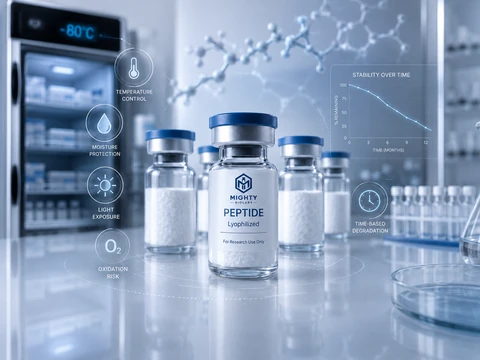
Overview
Peptide stability describes the ability of a peptide material to retain its intended chemical identity, purity, concentration and physical state over time. A peptide can become unstable through chemical reactions such as hydrolysis, oxidation or deamidation, and through physical changes such as aggregation, precipitation or adsorption to a container surface.
Storage is therefore not simply a question of whether a vial is kept cold. Temperature matters, but so do water activity, oxygen, light, pH, formulation, concentration, container closure and the number of times a material is moved between environmental conditions. A storage statement is meaningful only when it is tied to a defined formulation, package and period of time.
Many research peptides are supplied as lyophilized solids because removing most of the water generally reduces molecular mobility and slows several degradation pathways. Once a peptide is placed in solution, water again becomes available as a reaction medium and the material usually becomes more sensitive to its environment. The magnitude of that change is sequence- and formulation-dependent.
There is no universal shelf life for “peptides” as a category. Stability belongs to a specific peptide, formulation, concentration, container, storage condition and analytical acceptance criterion.
What Peptide Stability Actually Means
Stability is often discussed as though a material is either stable or unstable. In pharmaceutical and analytical science, it is better understood as a measurable rate of change. A peptide may remain within an established specification for a defined period while still undergoing gradual degradation.
Chemical stability concerns whether the molecular structure remains intact. Physical stability concerns attributes such as solubility, aggregation state, particle formation and appearance. Microbiological quality is a separate issue that becomes particularly important for aqueous preparations. Container-closure integrity and packaging compatibility also affect whether the original material remains protected.
- Identity: whether the intended molecular species remains present.
- Purity: whether degradants or related substances remain within defined limits.
- Content: whether the measurable amount or concentration remains acceptable.
- Physical state: whether the material remains soluble and free from unacceptable aggregation or precipitation.
- Package protection: whether moisture, oxygen, light and contamination remain adequately controlled.
These attributes are evaluated with methods selected for the material. A clear solution or intact lyophilized cake can be visually reassuring, but appearance alone cannot demonstrate molecular identity, chromatographic purity or concentration.
Intrinsic Factors: Why Sequence and Structure Matter
Two peptides stored in identical vials can have very different stability profiles. The amino-acid sequence determines which chemical reactions are possible and how readily the molecule can adopt structures that promote aggregation or surface interaction.
Residues containing sulfur, aromatic groups or chemically labile side chains may create specific vulnerabilities. Methionine and cysteine can be susceptible to oxidation. Asparagine and glutamine may undergo deamidation under certain conditions. Aspartic-acid-containing sequences can be vulnerable to isomerization or cleavage depending on neighbouring residues and pH. Tryptophan, tyrosine and disulfide-containing peptides may also respond to light or oxidative stress.
Peptide length, net charge, hydrophobicity and secondary structure influence solubility and aggregation. A hydrophobic peptide may adsorb strongly to glass or plastic, while a peptide with limited solubility may precipitate as concentration, pH or ionic strength changes. Post-translational modifications, conjugated groups and counterions can introduce additional stability considerations.
Common Chemical Degradation Pathways
Hydrolysis
Hydrolysis is the cleavage of a chemical bond through reaction with water. Peptide bonds are relatively stable under many conditions, but susceptible sequences, extreme pH, elevated temperature and extended time can increase hydrolytic degradation. Other bonds within a modified peptide or conjugate may be more labile than the peptide backbone itself.
Oxidation
Oxidation can modify susceptible amino-acid side chains and alter mass, charge, conformation or biological characteristics. Dissolved oxygen, trace metals, light and peroxide impurities in formulation components may contribute. Lower temperature can slow oxidation, but oxygen control, compatible excipients and protective packaging may also be required.
Deamidation and isomerization
Asparagine and glutamine residues can lose amide groups, creating related species with altered charge. Aspartic acid and asparagine can also form isomerized products through cyclic intermediates. Reaction rates are influenced strongly by sequence context, pH, temperature and formulation.
Disulfide exchange and reduction
Peptides containing cysteine or disulfide bonds may undergo reduction, scrambling or exchange reactions. These changes can alter the intended connectivity of the molecule even when the overall amino-acid composition remains unchanged.
Other reactions
Depending on structure and conditions, peptides may experience racemization, beta-elimination, clipping or modification of terminal groups. The relevant degradants must be established through forced-degradation studies and stability-indicating analytical methods rather than assumed from appearance.
Physical Instability: Aggregation, Precipitation and Surface Loss
A peptide may remain chemically intact yet become unsuitable for an intended analytical workflow because of a physical change. Aggregation can produce soluble oligomers, visible particles or precipitate. These changes may be promoted by concentration, agitation, interfaces, freezing, pH shifts or exposure to hydrophobic surfaces.
Adsorption is especially important at low concentrations. A meaningful fraction of peptide can bind to vial walls, pipette tips, filters or tubing, creating apparent loss of content without chemical degradation. The effect depends on the peptide, surface chemistry, concentration, contact time and formulation.
Aggregation
Molecules associate into larger structures that may remain soluble or form visible particles.
Precipitation
Solubility is exceeded and material separates from solution.
Adsorption
Peptide binds to glass, plastic, filters or other contact surfaces.
Interfacial stress
Air-liquid, ice-liquid and solid-liquid interfaces can promote structural change.
Environmental Factors That Control Stability
Temperature
Higher temperatures generally accelerate chemical reactions by increasing molecular motion and reaction rates. Refrigerated or frozen storage can therefore extend the time required for degradation to reach a specification limit. Cold storage does not stop reactions completely, and inappropriate freezing can create its own stresses.
Moisture and humidity
Residual moisture affects molecular mobility in a lyophilized matrix. Humidity entering an opened vial or through an inadequate closure can plasticize the dried material, alter cake structure and accelerate chemical change. Moisture protection is therefore part of both the formulation and the container-closure system.
Oxygen
Oxygen in the vial headspace, dissolved in solution or permeating through packaging can support oxidation. Susceptibility depends on sequence and formulation. In some products, headspace control and oxygen-barrier packaging are as important as temperature.
Light
Ultraviolet and visible light can initiate direct photochemical reactions or generate reactive species. Light-sensitive materials may require amber containers, secondary cartons or minimized exposure during laboratory handling.
pH and ionic environment
pH influences hydrolysis, deamidation, oxidation, solubility and charge state. Buffer identity and ionic strength can also affect aggregation and surface interaction. A pH that improves chemical stability may worsen physical stability, so formulation development often requires balancing competing risks.
Storage of Lyophilized Peptides
Lyophilization places the peptide in a low-moisture matrix. This commonly improves storage potential, but the dry state is not automatically permanent or insensitive to its surroundings. The glass transition temperature, residual moisture, excipient system and package barrier determine how well the matrix restricts molecular movement.
Sealed vials should be protected from conditions outside the manufacturer’s validated range. Repeated opening can introduce humidity and oxygen. Temperature cycling may create condensation, especially if a cold vial is opened before it equilibrates to the surrounding environment. Container damage, loose caps or compromised stoppers can eliminate the protection expected from a sealed presentation.
Visual features such as cake height, cracking or slight shrinkage are influenced by the lyophilization cycle and excipients. They are not independent measurements of potency or purity. Significant collapse, melt-back, discoloration, foreign matter or a damaged closure may warrant investigation, but acceptable appearance still requires supporting analytical data.
For a detailed explanation of the manufacturing process, see What Is Lyophilization? Understanding Freeze-Dried Peptides.
Stability After a Peptide Enters Solution
In solution, the peptide is exposed to water, dissolved oxygen, container surfaces and any impurities present in the solvent or formulation components. Molecular mobility increases, and pH-dependent degradation pathways can proceed more readily. For many peptides, this means the useful stability period is shorter than in the sealed lyophilized state.
Solution stability depends on concentration, solvent composition, buffer, pH, ionic strength, preservatives where applicable, container material, headspace and storage temperature. A generalized statement such as “stable in the refrigerator” is incomplete unless the formulation and acceptance criteria are known.
Microbiological risk is also distinct from chemical stability. A peptide can remain chemically intact while a solution becomes contaminated, and a sterile appearance does not establish microbiological quality. Laboratory procedures should follow institutional controls appropriate to the material and intended analysis.
Freezing and Freeze–Thaw Stress
Freezing may slow chemical degradation, but the freezing event is not inert. As ice forms, the remaining liquid becomes more concentrated in peptide, buffer salts and other solutes. Local pH can shift, and the peptide is exposed to ice-liquid interfaces. Some buffers crystallize selectively, changing the composition of the unfrozen phase.
During thawing, concentration gradients may persist until the sample is fully mixed. Repeated freeze–thaw cycles repeat these stresses and can increase aggregation, precipitation or particle formation in susceptible materials. The significance varies greatly among peptides and formulations.
“Frozen” describes a storage state. “Freeze–thaw stability” describes whether a specific formulation tolerates the transitions into and out of that state without unacceptable change.
Container, Closure and Packaging Considerations
The container is part of the stability system. Borosilicate glass, cyclic olefin polymers and other materials differ in surface chemistry, gas permeability, extractables and breakage risk. Elastomeric stoppers and seals must maintain closure integrity across the intended temperature range.
Low-concentration peptides may be especially vulnerable to adsorption. Silicone oil, tungsten residues, plasticizers, peroxide impurities and trace metals are examples of material-related factors that may need consideration depending on the package and analytical sensitivity.
Secondary packaging can protect against light, impact and temperature excursions. Labels and data systems also matter: a stable sample can become unusable if its identity, preparation date, storage history or chain of custody is uncertain.
Shipping and Temperature Excursions
Shipping exposes materials to variable temperatures, vibration and time away from controlled storage. Lyophilized products often tolerate transport better than solutions, but tolerance must be demonstrated for the specific product. A brief excursion does not automatically establish damage, just as an insulated package does not prove that the validated range was maintained.
Excursion assessment considers the actual temperature profile, duration, product state, package configuration and available stability data. Mean kinetic temperature can sometimes help describe cumulative thermal exposure, but it does not replace product-specific evaluation and is not appropriate for every type of excursion.
How Stability Is Demonstrated
Stability claims are supported through studies performed at defined conditions and time points. Long-term studies evaluate the proposed storage condition. Accelerated and intermediate studies provide information about degradation trends and packaging performance. Stress studies use more severe conditions to reveal likely degradation pathways and confirm that analytical methods can distinguish intact peptide from its degradants.
A stability-indicating program may include:
- Chromatographic purity and related-substance testing by HPLC or UHPLC.
- Identity and degradant characterization by mass spectrometry.
- Assay or peptide-content measurement using a validated quantitative method.
- Residual moisture testing for lyophilized materials.
- Appearance, clarity, colour, visible-particle and pH testing where relevant.
- Aggregation analysis using size-exclusion chromatography or other suitable techniques.
- Container-closure integrity and package compatibility evaluation.
A Certificate of Analysis may report selected release tests, but it usually does not contain the complete stability data package. Release testing answers whether a batch met specification at a particular point; stability studies evaluate how attributes change over time under defined conditions.
Common Storage Misconceptions
“Colder is always better.”
Lower temperature can slow reactions, but freezing can create concentration, interface and precipitation stresses. The correct condition is product-specific.
“A sealed dry vial cannot degrade.”
Oxidation, residual-moisture effects, light exposure and temperature-dependent reactions can continue in the dry state.
“A clear solution is still pure.”
Many chemical degradants remain fully dissolved and invisible. Appearance cannot substitute for chromatography or mass spectrometry.
“All peptides have the same refrigerator shelf life.”
Sequence, formulation, concentration and packaging create materially different stability profiles.
“Freezing resets the clock.”
Freezing slows many processes but does not reverse degradation that has already occurred.
“A COA proves long-term stability.”
A release COA documents specified tests for a batch. Shelf-life claims require time-dependent stability evidence.
Frequently Asked Questions
Do all peptides require the same storage conditions?
No. Stability depends on sequence, formulation, concentration, packaging and intended storage period. Product-specific documentation and validated stability data should take precedence over general rules.
Are lyophilized peptides more stable than peptide solutions?
Many peptides are more stable as dry, lyophilized solids because reduced water content slows hydrolysis and molecular mobility. Lyophilization does not eliminate oxidation, light sensitivity or temperature-related degradation.
Why should repeated freeze–thaw cycles be minimized?
Freezing can concentrate solutes and create ice-liquid interfaces. Repeated cycles can increase aggregation, precipitation or chemical change in susceptible peptide solutions.
Can appearance confirm that a peptide is stable?
No. A normal-looking powder or clear solution can still contain degraded material, and some harmless physical variation may be visible. Stability requires appropriate analytical testing.
Does refrigeration stop peptide degradation?
No. Lower temperatures generally slow many reactions, but degradation can continue. Refrigeration also does not correct contamination, unsuitable pH, light exposure or poor container closure.
Why does container selection matter?
Peptides can adsorb to glass or plastic surfaces, interact with extractables, or be affected by oxygen and moisture entering through the closure. Container compatibility is part of stability assessment.
Key Takeaways
Stability belongs to a defined peptide, formulation, package and condition.
Lyophilization slows important pathways but does not eliminate degradation.
Water, oxygen, pH and surfaces become more influential after dissolution.
Freeze–thaw tolerance must be demonstrated for the specific formulation.
Container surfaces, closures, light barriers and traceability affect usable stability.
Appearance and release documentation cannot replace stability-indicating studies.
Conclusion
Peptide stability is controlled by the interaction of molecular structure, formulation, environment and packaging. Temperature is important, but it is only one variable within a larger system that includes moisture, oxygen, light, pH, concentration, surfaces and time.
Lyophilization often provides a more stable presentation by reducing water and molecular mobility. Once a peptide enters solution, degradation and physical-instability risks generally become more prominent. Freezing may extend stability for some formulations, but transitions through freezing and thawing can also introduce stress.
Reliable storage claims come from product-specific, stability-indicating data. Laboratory users should therefore prioritize controlled documentation, defined storage histories and appropriate analytical verification rather than relying on vial appearance or generalized timelines.
Scientific References
- Manning MC, Chou DK, Murphy BM, Payne RW, Katayama DS. Stability of protein pharmaceuticals: an update. Pharmaceutical Research. 2010;27:544–575.
- Wang W. Instability, stabilization, and formulation of liquid protein pharmaceuticals. International Journal of Pharmaceutics. 1999;185(2):129–188.
- Wang W. Lyophilization and development of solid protein pharmaceuticals. International Journal of Pharmaceutics. 2000;203(1–2):1–60.
- Patel A, Cholkar K, Mitra AK. Recent developments in protein and peptide parenteral delivery approaches. Therapeutic Delivery. 2014;5(3):337–365.
- International Council for Harmonisation. ICH Q1A(R2): Stability Testing of New Drug Substances and Products.
- International Council for Harmonisation. ICH Q1B: Photostability Testing of New Drug Substances and Products.
- U.S. Food and Drug Administration. Container Closure Systems for Packaging Human Drugs and Biologics.
References are provided for scientific context. External links open in a new tab. Product-specific storage decisions require validated documentation for the material being handled.