
Overview
Certificates of Analysis are useful only when the report is authentic, traceable to the correct sample and interpreted within the limits of the tests performed. Janoshik Laboratories—also presented publicly as Janoshik Analytical—is frequently referenced in markets involving peptides, anabolic compounds, SARMs and pharmaceutical-related materials.
The laboratory describes itself as specializing in chemical analysis and states that it has more than ten years of experience with performance-enhancing drugs and related compounds. Its public website lists peptide testing, HPLC-based analyses, LC-MS-related services and additional testing options for selected materials.
The laboratory's visibility does not remove the need for critical review. A genuine report confirms what the laboratory reported for the submitted sample. It does not, by itself, prove that a later vial, shipment or production batch is the same material.
Background and Public History
Janoshik's public history is described in broad terms rather than as a detailed corporate chronology. Its official About page states that the organization has more than ten years of experience in chemical analysis of performance-enhancing drugs and related compounds. The laboratory now presents a global sample-submission service, a customer portal, secure digital reports, official report verification and a database of public tests.
Because the laboratory's own website is the primary source for this history, the most defensible description is limited: Janoshik developed from a specialized analytical service into a widely used independent testing provider with a public verification system. Claims beyond the laboratory's published information should be treated cautiously unless supported by separate records.
Janoshik analyzes samples submitted by clients. A report identifies the tested submission; it does not certify an entire vendor, every product carrying the same name, or future batches.
What Janoshik Reports May Cover
The scope depends on the test ordered. Janoshik's service catalogue includes analyses for peptides and other compounds, and individual service pages specify which attributes are measured. Depending on the material and selected options, a report may address:
Identity
Whether the analytical response is consistent with the named compound, commonly using mass-spectrometric or chromatographic evidence.
Amount or content
The measured amount in a vial, tablet or submitted sample when a quantitative method is part of the ordered service.
Chromatographic purity
The relative prominence of the principal component under the reported HPLC method and calculation basis.
Additional attributes
Selected services may offer options such as endotoxin, sterility, TFA, variance or raw-data packages. These must be ordered and reported separately.
Do not infer unreported attributes. An HPLC purity result is not a sterility test. Identity confirmation is not automatically a quantitative fill measurement. Endotoxin status cannot be inferred from a clean chromatogram.
Anatomy of a Janoshik Analytical Report
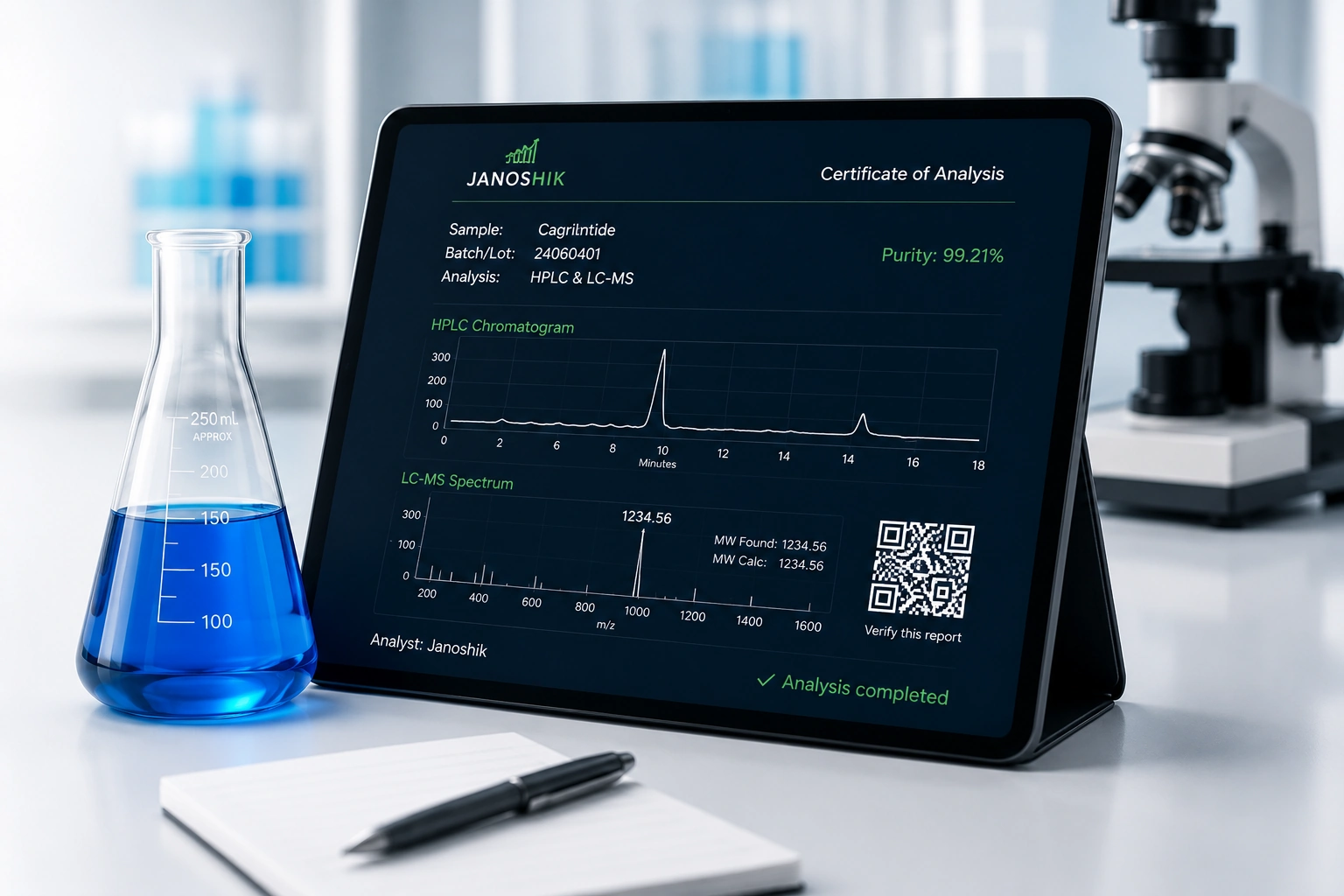
Report formats can change, but the verification process depends on identifiers associated with the issued test. A supplied report should be reviewed for:
| Field | What to confirm | Why it matters |
|---|---|---|
| Task or test number | The number shown on the document and official record | Links the document to a specific laboratory task |
| Unique key | The report-specific verification key | Helps authenticate access to the official record |
| Sample name | Compound, formulation and stated strength | Prevents a report for another material from being substituted |
| Client or manufacturer fields | Any named submitter or declared source | Provides context but does not independently prove chain of custody |
| Test performed | Identity, amount, purity or additional test | Defines what the result can legitimately support |
| Results and units | Measured value and calculation basis | Prevents purity, amount and concentration from being confused |
| Date and status | Issued report and current verification record | Supports document control and chronology |
How to Verify a Janoshik Report
- 01Use the official verification page
Navigate directly to Janoshik's official verification page. Avoid relying solely on a QR destination or link copied into a vendor's webpage, because displayed links can be altered.
- 02Enter both required identifiers
The official form requests a task number and a unique key. Enter the values exactly as printed on the report. A task number alone is not the complete verification process.
- 03Confirm that an official record resolves
A successful lookup should lead to an official Janoshik record associated with that report. Confirm that the browser remains on a legitimate Janoshik domain and that the task number matches.
- 04Compare the official record line by line
Check the sample name, stated strength, analysis type, result, dates and any client or source fields. Verification is not complete merely because a page opens.
- 05Match the report to the physical batch
Compare the report's batch, lot or sample identifiers with the label and supplier documentation. When no batch-level identifier connects the vial to the report, the chain of evidence remains incomplete.
- 06Review attachments and analytical pages
Where the official record provides downloadable pages or analytical images, compare them with the supplied document. Look for missing pages, altered values, inconsistent branding or different sample descriptions.
An authentic report and a batch match are two separate checks. The official lookup authenticates the laboratory record; traceability connects that record to the material in front of you.
Using QR Codes Safely
A QR code is a convenience, not independent proof. Before entering information or accepting the result:
- Preview the destination and confirm that it uses an official Janoshik domain.
- Prefer typing or bookmarking the official verification page when the destination appears unusual.
- Do not treat a screenshot of a verification page as equivalent to a live lookup.
- Repeat the lookup yourself instead of relying on a vendor's statement that a report was verified.
How to Interpret the Verified Results
After authentication, interpret only the attributes that were actually tested. The report title and method description should control the conclusion.
Purity is method-dependent
An HPLC area percentage generally describes the proportion of included detector response assigned to the principal peak under the reported conditions. It is not automatically equivalent to target compound by total vial mass.
Identity and amount are different questions
Mass-spectrometric evidence may support molecular identity, while a calibrated quantitative method may address amount. One should not be silently substituted for the other.
Additional safety-related attributes require separate tests
Sterility, bacterial endotoxin, residual solvents, water content and other attributes require appropriate dedicated analyses. A verified report that does not contain those tests makes no claim about them.
Common Red Flags
Only a task number is shown
The unique key is missing, or the supplied document cannot be independently entered into the official verification form.
The official record differs
The sample name, stated amount, results or test type do not match the PDF or image supplied by the vendor.
No batch connection
The report is genuine, but no lot or sample identifier connects it to the material being sold.
One report covers indefinite inventory
An old test is repeatedly presented for later batches without evidence of batch-specific sampling.
Purity is treated as universal proof
A single percentage is presented as proof of identity, amount, sterility, endotoxin status and stability.
Verification is only a screenshot
The source provides an image of a result page but no identifiers that permit an independent live lookup.
What Verification Does Not Prove
Successful verification establishes that Janoshik issued the corresponding analytical record. It does not independently establish:
- that the tested sample was representative of an entire production batch;
- that the vial currently being evaluated came from that tested batch;
- that storage and shipping conditions preserved the material after testing;
- that unreported contaminants or quality attributes were assessed;
- that the material is suitable, approved or safe for human or veterinary use.
These limitations are not unique to Janoshik. They apply broadly to third-party analytical reports whenever sample custody and batch traceability are separate from laboratory testing.
Practical Verification Checklist
Perform the lookup on Janoshik's own verification service.
Use both the task number and unique key.
Compare sample, amount, test, result and dates.
Connect the report to the material's lot or sample identifier.
Draw conclusions only from tests explicitly performed.
Do not rely on screenshots, copied pages or vendor assurances.
Frequently Asked Questions
How do I verify a Janoshik report?
Use the official verification page and enter both the task number and unique key shown on the report. Then compare the returned official record with the document and batch information you received.
Does a successful verification prove that my vial was tested?
No. It proves that the laboratory issued the report. A separate batch or sample identifier must connect your material to the submitted sample.
Can a high HPLC purity result replace identity or amount testing?
No. Purity, identity and amount are distinct analytical questions and should be supported by the appropriate reported methods.
Is Mighty BioLabs affiliated with Janoshik?
No. This is an independent educational article and does not imply affiliation, endorsement or sponsorship.
Key Takeaways
Janoshik's official verification system provides a direct way to authenticate an issued laboratory record using a task number and unique key. Proper review does not stop at a successful lookup: the official record must match the supplied report, and the report must be traceable to the relevant batch. Finally, conclusions must remain limited to the tests that were actually ordered and reported.
Sources and Further Reading
- Janoshik — About Us. Public description of experience, scope and laboratory positioning. Accessed July 24, 2026.
- Janoshik — Official Verification. Task-number and unique-key verification form. Accessed July 24, 2026.
- Janoshik — Services. Public overview of available analytical categories. Accessed July 24, 2026.
- Janoshik Analytical — Public Tests. Publicly available test records. Accessed July 24, 2026.
- Mighty BioLabs — Understanding Certificates of Analysis (COAs). Background on identity, purity, assay, traceability and COA limitations.