
Overview
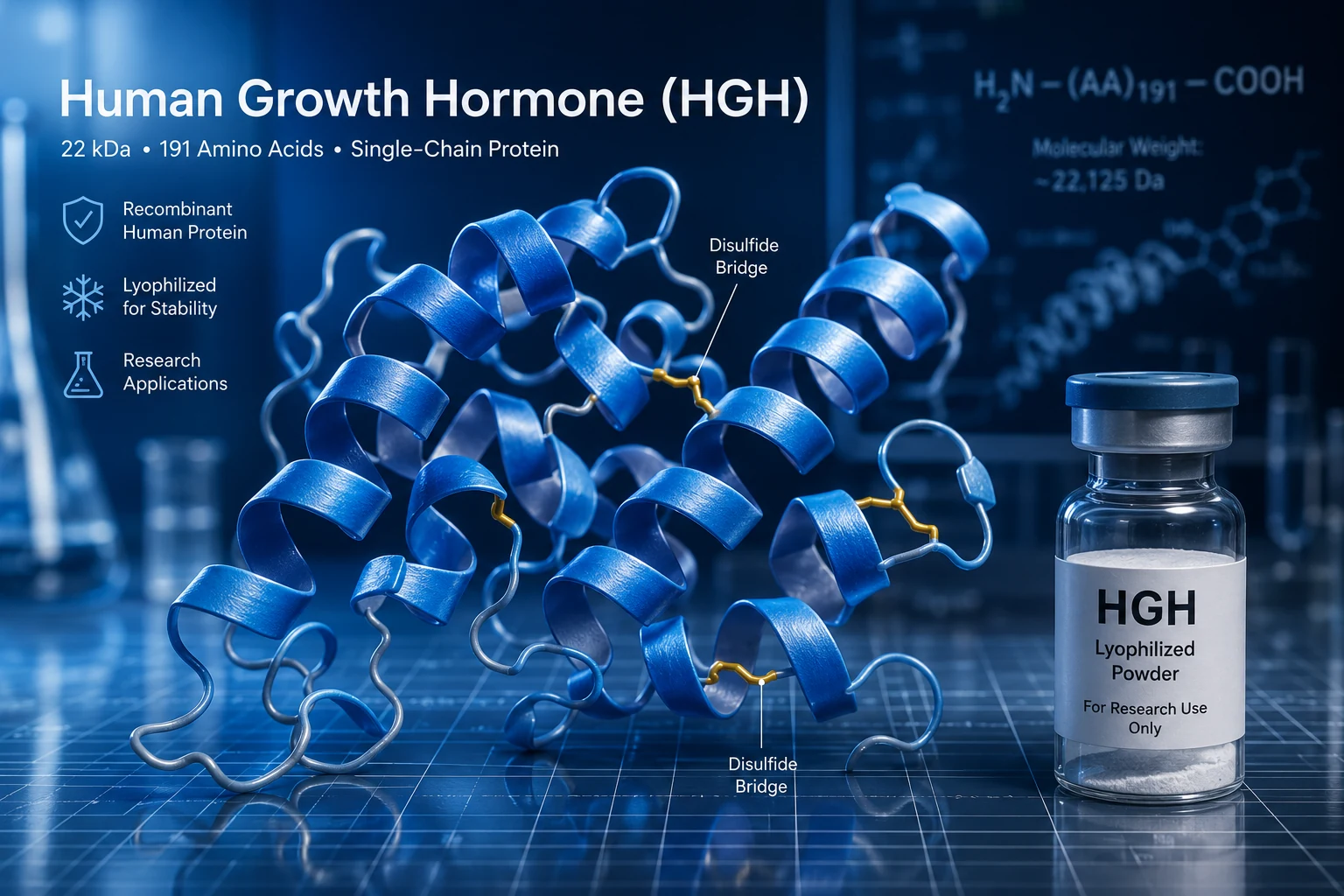
Human growth hormone (HGH), also called somatotropin, is a protein hormone encoded by the GH1 gene. The predominant mature form is a single chain of 191 amino acids with a molecular mass of approximately 22 kDa. Structural databases describe a compact, predominantly alpha-helical protein stabilized by disulfide linkages.
In laboratory research, recombinant HGH can serve as a model for protein expression, purification, structural characterization, receptor-binding analysis, formulation development and stability-indicating method design. Because HGH is a folded protein rather than a short linear peptide, analytical control must address not only sequence and purity but also aggregation, oxidation, deamidation and conformational integrity.
Molecular structure
The crystallographic structure of wild-type human growth hormone shows a single protein chain organized around a four-helix bundle. The deposited 1HGU structure contains 191 residues and has a structure weight near 21.9 kDa. Disulfide bonds constrain parts of the chain and contribute to the native fold.
Two samples can have similar nominal sequence and still differ in aggregation state, oxidation, deamidation or higher-order structure. These changes may affect chromatographic behaviour, receptor binding and assay performance.
Receptor and signalling research context
Growth hormone binds the growth hormone receptor (GHR), promoting receptor association and downstream signalling that includes the JAK2–STAT5 pathway. In research settings, this system is studied through receptor-binding experiments, cell-based signalling assays and protein-engineering models.
These biological systems are useful for understanding ligand–receptor specificity and for evaluating whether an analytically characterized protein retains the functional properties expected from its molecular identity. Analytical purity alone does not establish biological activity; that question requires an appropriately controlled bioassay.
Recombinant production
Recombinant human growth hormone is commonly produced using engineered expression systems. Published manufacturing studies describe bacterial expression, recovery from soluble or insoluble fractions, refolding where required, and multiple purification steps. The process must control host-cell proteins, product-related variants, aggregates and chemical modifications.
- Expression: a host system produces the encoded protein.
- Recovery and purification: chromatography separates the target protein from process-related impurities.
- Structural confirmation: mass spectrometry, electrophoresis and spectroscopic tools can support identity and integrity.
- Formulation: excipients and drying conditions are selected to protect the protein during processing and storage.
- Batch testing: identity, purity, content and other specifications are evaluated against defined methods.
Stability and degradation pathways
HGH stability depends on formulation composition, moisture, temperature, oxygen exposure, container integrity and molecular mobility in the solid state. Research on freeze-dried HGH has characterized degradation routes including methionine oxidation, asparagine deamidation and irreversible aggregation.
| Risk | What may change | Analytical indication |
|---|---|---|
| Oxidation | Side-chain chemistry | Mass shift or variant peaks |
| Deamidation | Charge and mass | Charge-variant or peptide-mapping changes |
| Aggregation | Oligomeric state | Size-exclusion or light-scattering response |
| Moisture uptake | Solid-state mobility | Water-content and accelerated-stability trends |
| Conformational change | Higher-order structure | Spectroscopic or bioassay differences |
Lyophilization removes most water and can improve storage stability, but it does not make a protein inherently insensitive to environmental conditions. Formulation, residual moisture and the glass-transition behaviour of the dried matrix remain important.
Laboratory handling considerations
Protein research materials should be handled according to the documented formulation and the needs of the analytical method. Laboratory plans commonly account for temperature exposure, repeated freeze–thaw events, adsorption to surfaces, sample concentration, mixing intensity and time in solution.
- Document sample identity, lot number and preparation time.
- Use compatible containers and calibrated volumetric equipment.
- Avoid unnecessary agitation that may promote foaming or interface stress.
- Design aliquoting and storage plans to limit repeated environmental cycling.
- Include blanks, system-suitability controls and reference materials where appropriate.
Analytical characterization
A defensible HGH characterization strategy combines methods that answer different questions.
Support molecular identity, sequence coverage and detection of selected modifications.
Profiles hydrophobic variants and supports purity or related-substance assessment under a defined method.
Evaluates monomer, aggregate and fragment distributions.
Provides orthogonal separation by size or charge-related behaviour.
Can investigate secondary or higher-order structural features.
Evaluates receptor-mediated functional response under controlled conditions.
Quality control and COA interpretation
A batch-specific Certificate of Analysis should identify the tested lot, analytical method and result. For a recombinant protein, a useful quality package may include identity evidence, purity or related-substance results, content or assay, aggregation assessment and relevant physical attributes.
Terms such as “purity” require method context. A reversed-phase chromatographic area percentage does not independently establish molecular identity, protein content, sterility, endotoxin status or biological activity. Researchers should assess whether the reported method is fit for the claim being made.
See Understanding Certificates of Analysis for a detailed framework and Understanding Peptide Stability and Storage for broader stability principles.
Frequently asked questions
How large is the predominant human growth hormone protein?
The predominant mature form contains 191 amino acids and has a molecular mass of approximately 22 kDa.
Why use multiple analytical methods?
Identity, purity, aggregation, chemical modification, higher-order structure and biological activity are different attributes. Orthogonal methods provide complementary evidence.
Why is HGH often lyophilized?
Removing water can reduce selected degradation processes and improve storage practicality. Stability still depends on formulation, residual moisture, packaging and environmental conditions.
Does HPLC purity establish activity?
No. Chromatographic purity does not independently establish receptor-mediated biological activity. A suitable bioassay is required.
Key takeaways
HGH is a 191-amino-acid protein whose higher-order structure is analytically important.
No single method establishes identity, purity, aggregation and activity.
Lyophilization helps, but moisture, temperature and matrix properties remain important.
Functional response requires an appropriate biological assay.
References
- UniProt. Somatotropin (GH1), Homo sapiens. Entry P01241.
- RCSB Protein Data Bank. 1HGU: Human Growth Hormone.
- RCSB Protein Data Bank. 1HWH: Human Growth Hormone–Receptor Complex.
- Hepner F, et al. Mass spectrometrical analysis of recombinant human growth hormone. Proteome Science. 2005.
- Kim MJ, et al. Solubilization, purification and characterization of recombinant human growth hormone. 2013.
- Pikal MJ, et al. Formulation variables and the stability of freeze-dried human growth hormone. 1991.
- Jiang H, et al. Mass spectrometric characterization of recombinant human growth hormone. 2009.
- Catai JR, et al. Analysis of recombinant human growth hormone by capillary electrophoresis and mass spectrometry. 2007.
External sources are provided for scientific context. Links open in a new tab.